
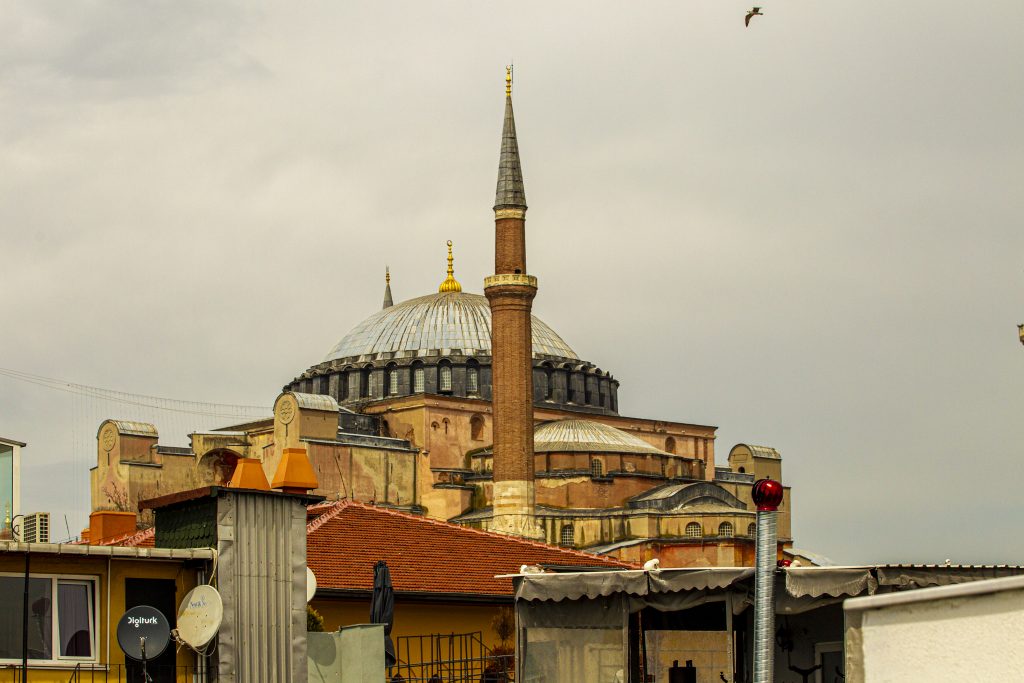
Hagia Sophia Mosque İs 5 Minutes From Our Hotel.
Hagia Sophia (meaning: “Holy Wisdom”; Greek: Ἁγία Σοφία, romanized: Agia Sofia), formerly the Holy Wisdom Church and Hagia Sophia Museum, or today officially known as Hagia Sophia-i Kebîr Câmi-i Şerîfi (Holy Great Hagia Sophia[4]) 5] is a mosque and former basilica, cathedral and museum located in Istanbul. It was a basilica planned patriarchal cathedral built by the Byzantine Emperor Justinian I between 532-537 in the old city center of Istanbul’s historical peninsula. After the conquest of Istanbul by the Ottomans in 1453, II. It was converted into a mosque by Mehmed. It was converted into a museum by the Decree of the Council of Ministers published by Mustafa Kemal Atatürk in 1934, excavation and renovation works were started and it served as a museum from 1935 to 2020. In 2020, the status of a museum was canceled and the status of a mosque was given.
Hagia Sophia is a domed basilica type building that combines the central plan in terms of architecture, and is considered an important turning point in the history of architecture with its dome passage and carrier system features. For Christians, it is a touristic and spiritual center of attraction, as well as being both a symbolic and an axis.
The word “Aya” in the name of Hagia Sophia means “holy”. The word “Sophia” comes from the Greek word sophos, meaning “wisdom”.[6] Therefore, the name “Hagia Sophia” means “Holy Wisdom” or “Divine Wisdom” in reference to Jesus of Nazareth and is considered one of the three attributes of God in Christian theology.[7][8] It is stated that approximately 10,000 workers[10][11][12] worked in the construction of Hagia Sophia, which was directed by Isidore of Miletus and Antemius of Tralles[3][9], and Emperor Justinian I spent a great fortune for this work.[13] A feature of this very old building is that some of the columns, doors and stones used in its construction were brought from earlier structures and temples.
During the Byzantine Empire, Hagia Sophia had a great wealth of “sacred relics”. One of these relics was the 15-meter-high silver iconostasis.[16] The church of the Patriarch of Constantinople and the center of the Eastern Orthodox Church for 1000 years, Hagia Sophia was founded in 1054 by Patriarch Michael I, Pope IX. Witnessing his excommunication by Leo, this event is generally regarded as the beginning of “Schisma”, that is, the separation of the Eastern and Western churches, one of the most important events in the history of Christianity.
In 1453, the church was built by the Ottoman Sultan II. After it was converted into a mosque by Mehmed, the mosaics containing human figures were not destroyed (the ones that did not contain them were left as they were), only the mosaics covered with a thin plaster and plastered for centuries were thus spared from natural and artificial destruction. While the mosque was being converted into a museum, some of the plasters were removed and the mosaics were again brought to light. The Hagia Sophia building seen today is also known as the “Third Hagia Sophia” since it is actually the third church built on the same place. The first two churches were destroyed during the riots. The central dome of Hagia Sophia, which was the widest dome of its period, collapsed once (on May 7, 558) during the Byzantine period,[17][18] It has never collapsed since the Ottoman chief architect Mimar Sinan added buttresses to the building.